EDWARD'S LECTURE NOTES:
More notes at http://tanguay.info/learntracker
C O U R S E
The Bible's Prehistory, Purpose, and Political Future
Dr. Jacob L. Wright, Emory University
 |
C O U R S E L E C T U R E The Kingdom of Judah and Sennacherib Notes taken on November 17, 2014 by Edward Tanguay |
•
Assyria has now conquered Samaria
•
reduced the Kingdom of Israel to a small, petty kingdom
•
within a couple decades, they would do the same to Israel's southern neighbor, the Kingdom of Judah
•
the Syro-Ephraimite War
•
took place in the 8th century BC
•
Assyria was a great regional power
•
the smaller nations of Syria (Aram) and the northern Kingdom of Israel (Ephraim) formed a coalition against Assyria
•
King Pekah of Israel joined King Rezin of Aram-Damascus in an attempt to place a new ruler on the throne in Jerusalem
•
this was an anti-Assyrian coalition
•
the Biblical authors present a very Jerusalem-centered view of these events
•
the end of the rule of Tiglath Pileser III (727 BC) marks the beginning of Judah as an independent kingdom in its own right
•
King Ahaz rules from 731 to 716 BC
•
King Hezekiah (son of Ahaz)
•
13th king of Judah
•
reign 715 - 686 BC
•
one of the most prominent kings of Judah mentioned in the Hebrew Bible
•
an age of state centralization
•
a growing national pride in the Kingdom of Judah
•
cities gates became impressive
•
water supply was protected
•
reigns of Ahax and Hezekiah were a time of great internal development
•
Judah blooming with texts and signs of more widespread literacy
•
stamped jar handles attest to an infrastructure that controlled the transport of olive oil, wine, and other precious commodities
•
in many ways, Judah's prosperity was a result of Assyria's expansion
•
destroyed Judah's more powerful northern competitors
•
Assyria might have been using Judah economically as a source of olive oil production
•
however, after destroying Israel's olive oil production, Assyria also destroyed that of Judah
•
at first Judah pursued peace an demonstrated loyalty to the Assyrian empire
•
but eventually revolted
•
first with the help of Egypt
•
then after the death of Sargon II in 705, Judah made a renewed effort to rebel
•
but Sargon's son, Sennacherib, once becoming ruler, laid waste to Judah's richest region
•
destroyed its means of olive oil production
•
included the destruction of Lachish
•
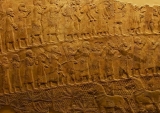
horrifying reliefs in British Museum showing this
•
Assyrians besieged Lachish and deported its population
•
Sennacherib makes Hezekiah a prisoner in his own city, "like a bird in a cage"
•
the Biblical account fails to mention the great devastation at Lachish [lah-KEESH]
•
presents Jerusalem as being divinely rescued, Isiah plays a large role in that
•
after Sennacherib
•
Judah was reduced to a "rump state in the hill country"
•
ironically, the city of Jerusalem became densely populated throughout the 7th century
•
due to incursions from the north, from Israel
•
although some archeologists say this was more just a redistribution of population within Judah