EDWARD'S LECTURE NOTES:
More notes at http://tanguay.info/learntracker
C O U R S E
Programming Mobile Applications for Android
Adam Porter, University of Maryland
 |
C O U R S E L E C T U R E Android Permissions Notes taken on June 30, 2014 by Edward Tanguay |
•
Android uses permissions to protect resources
•
which applications can use cost-sensitive APIs, e.g. SMS
•
protects user information
•
system resources such as the camera
•
permissions are represented as strings
•
stored in
AndroidManifest.xml file•
when application wants to use a permissions
•
specifies a
uses-permission tag in AndroidManifest.xml file•
when user installs, has to accept this permission

•
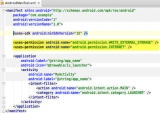
in the earlier application, we access the contacts on the phone, here is how the app requrested the permission:

•
Android applications can also define and enforce permissions
•
e.g. your application performs a priviledged/dangerous operation
•
you want to put a permission on it so other applications can't invoke it
•
e.g. you have an app that formats an external memory card
•
the application can be started just by touching icon
•
AndroidManifest.xml file

•
any other application that wants to use it will have to acquire the permission
•
if it doesn't have permission
•
second application
•
will get permission error
•
to fix that, add element:

•
Android even allows you to set permission for components
•
Activity permissions
•
startActivity()
•
startActivityForResult()
•
Service Permissions
•
Context.startService()
•
Context.stopService()
•
Context.bindService()
•
BroadcastReceiver Permissions
•
ContentProvider Permissions